

Conversion between Binary and Other Number Systems
Binary numbers use digits 0 and 1 and have a base of 2. Converting a binary number to another number system involves changing its base. This guide outlines all conversions related to the binary system in a sequential, structured format.
1. Binary to Decimal Conversion (B → D)
A binary number is converted into a decimal number by multiplying each binary digit (0 or 1) by its corresponding power of 2 according to its positional place value, starting from 0 on the right.
Steps:
- Write the given binary number and assign powers of 2 from right to left (starting from 0).
- Multiply each binary digit by its corresponding power of 2.
- Add all the products together to get the final decimal number.
Solved Examples:
Q.1: Convert the binary number 1001 to a decimal number.
Q.2: Convert into an equivalent decimal number.
Q.3: Convert into the base-10 number system.
2. Decimal to Binary Conversion (D → B)
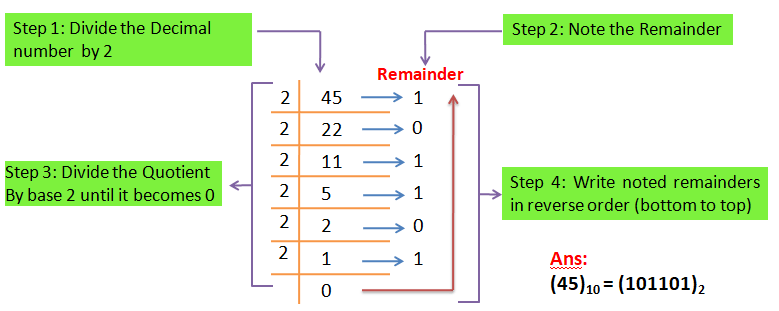
To convert a decimal number to binary, the number is repeatedly divided by 2, and the remainders are tracked until the quotient becomes 0.
Steps:
- Divide the decimal number by 2 and note down the remainder.
- Divide the resulting quotient by 2 again and note the remainder.
- Repeat the process until the quotient becomes 0.
- Read the remainders from bottom to top (from MSB to LSB) to get the binary equivalent.
Solved Examples:
Q.1: Convert to a binary number.
| Division | Quotient | Remainder |
|---|---|---|
| 25 ÷ 2 | 12 | 1 (LSB) |
| 12 ÷ 2 | 6 | 0 |
| 6 ÷ 2 | 3 | 0 |
| 3 ÷ 2 | 1 | 1 |
| 1 ÷ 2 | 0 | 1 (MSB) |
Reading remainders from bottom to top:
Q.2: Convert to a binary number.
| Division | Quotient | Remainder |
|---|---|---|
| 43 ÷ 2 | 21 | 1 (LSB) |
| 21 ÷ 2 | 10 | 1 |
| 10 ÷ 2 | 5 | 0 |
| 5 ÷ 2 | 2 | 1 |
| 2 ÷ 2 | 1 | 0 |
| 1 ÷ 2 | 0 | 1 (MSB) |
Reading remainders from bottom to top:
3. Binary to Octal Conversion (B → O)
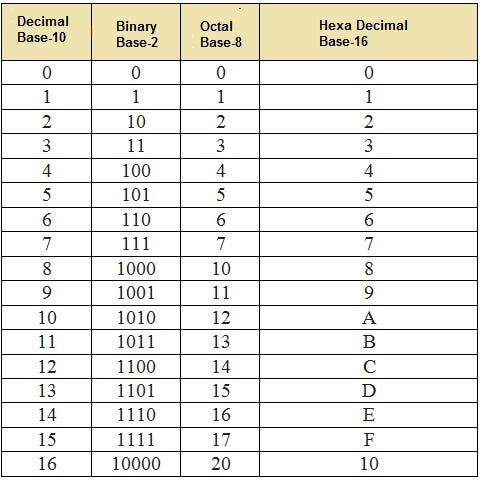
Binary numbers have a base of 2, while octal numbers have a base of 8 (). Thus, we group bits into sets of three.
Steps:
- Divide the binary number into groups of three digits starting from right to left (LSB to MSB).
- If the leftmost group has fewer than three digits, pad it with leading zeros.
- Convert each 3-digit group into its equivalent octal digit.
Solved Examples:
Q.1: Convert into an octal number.
| Binary Group | Octal Digit |
|---|---|
011 | 3 |
101 | 5 |
011 | 3 |
Leading zero added to leftmost group.
Result:
Q.2: Convert into an octal number.
| Binary Group | Octal Digit |
|---|---|
101 | 5 |
101 | 5 |
Result:
4. Octal to Binary Conversion (O → B)
To convert an octal number to binary, each individual octal digit is expanded into its 3-digit binary equivalent.
Steps:
- Write down each digit of the octal number separately.
- Convert each individual octal digit into its 3-bit binary equivalent.
- Combine all the binary groups together.
Solved Examples:
Q.1: Convert into a binary number.
| Octal Digit | Binary Group |
|---|---|
| 7 | 111 |
| 4 | 100 |
| 2 | 010 |
Result:
5. Binary to Hexadecimal Conversion (B → H)
Binary numbers have a base of 2, while hexadecimal numbers have a base of 16 (). Thus, we group bits into sets of four.
Steps:
- Divide the binary number into groups of four digits starting from right to left (LSB to MSB).
- Pad with leading zeros on the left if the last group has fewer than four digits.
- Convert each 4-bit group into its equivalent hexadecimal digit (0–9, A–F).
Solved Examples:
Q.1: Convert into a hexadecimal number.
| Binary Group | Hex Digit |
|---|---|
0001 | 1 |
1101 | D |
0110 | 6 |
1101 | D |
Three leading zeros added to leftmost group.
Result:
6. Hexadecimal to Binary Conversion (H → B)
To convert a hexadecimal number to binary, each hex digit is expanded into its 4-digit binary equivalent.
Steps:
- Write down each digit of the hexadecimal number.
- Convert each hex character into its 4-bit binary equivalent.
- Concatenate the groups to form the final binary string.
Solved Examples:
Q.1: Convert into a binary number.
| Hex Digit | Binary Group |
|---|---|
| 3 | 0011 |
| A | 1010 |
| 9 | 1001 |
Drop leading zeros from the final combined result.
Result:
Number Systems Conversion Map
               ┌──────────────────┐
               │     DECIMAL      │
               │    (Base 10)     │
               └────▲────────▲────┘
         Divide by 2│        │Sum weights (×2ⁿ)
                    │        │
               ┌────▼────────┴────┐
   ┌──────────►│      BINARY      │◄──────────┐
   │ 3-bit     │     (Base 2)     │   4-bit   │
   │ grouping  └────▲────────▲────┘  grouping │
   │                │        │                │
┌──▼───────────────┐│        │┌───────────────▼──┐
│      OCTAL       │┘        └│   HEXADECIMAL    │
│     (Base 8)     │          │    (Base 16)     │
└──────────────────┘          └──────────────────┘
Related Mathematical & Computing Guides
- Discrete Math & Number Theory: Review number theory, divisibility, and discrete formulas in the Mathematics Formula Cheat Sheet.
- Algorithmic Number Manipulation: See how modulo and base-10 digit extraction enable high-performance checks in How I Cut My Palindrome Algorithm’s Execution Time in Half.
- Memory Representation: See how binary words and addresses map to memory locations in Dynamic Memory Allocation.
- Pillar Hubs: Explore the complete Mathematics topic hub and Algorithms & DSA topic hub.